Tuesday, September 15, 2015

Labor of Love & Pop Up Art Festival Recap

WE DID IT!


Many of you have probably heard from our many facebook posts that our Russian Imperial Stout won the silver medal in its category at Deep Ellum's Labor of Love Homebrew Competition and Festival. Our first hardware! The judges score sheets commended the balance achieved between a large malt presence and just the right amount of bitterness to keep the finish somewhat dry. We are very happy with the results, and Amanda has advised that we brew this year-round to keep up a steady supply.

Judges' Comments

The festival was tons of fun. We want to thank everyone who stopped by and sampled our beer. We brought our Palo Alto Wit and a clone of Weihenstephan Hefeweissbier that we dubbed Hurricane Hefe (to keep with our nautilus-inspired spiral mantra), and a few bottles of the stout. We thought no one would want to drink stout when it's 100 degrees out, but we ran out of stout within the first hour! Everyone saw our medal and wanted a taste.

Beerhemoth in action!

The beerhemoth performed beautifully. After setting up at 3pm and packing out at about 10:30, there was still plenty of ice around each keg. The beer coming out of each tap was just the right temperature, and a lot of the foaming issues other folks had using standard jockey boxes did not rear their ugly heads for us. The hefeweizen was a little over-carbonated, which isn't a terrible thing for the style, but we were able to pour the perfect sample by dispensing into a small pitcher before pouring each taste. This is a standard trick of the trade for beers with high carbonation (into the 3.0+ volumes realm).

Our "menu"

We had a great time sampling everyone else's homebrew. I want to give a shout out to Steel Rain Brewing to congratulate them on the GOLD medal they won for their Saison. Seriously, that was an amazing Saison. Easily the best I've ever tasted. Great job, y'all! We should collaborate one of these Aggie game days and brew up something good.

We also had the opportunity to pour our homebrew for fellow Arlingtonians at the #CreateArlington Pop Up Art & Music Festival this past weekend. We met tons of great folks who had very kind remarks on our beers. We brought what was left of the Hefe, the Wit, a few bottles of RIS (those are starting to get scarce!), and the pale ale we brewed for our friend's bachelor party this summer. We had several folks who were self-proclaimed "not beer people" comment on how they could actually taste this stuff and that they really liked it. We met a nice young family who had recently returned to North Texas from a few years living in Houston, and they were relieved at the advances in the craft beer scene in the time they had been away. We even had a few globe-trotting beer fans tell us the hefeweizen tasted just like the German wheat beer they remember from their trip across the pond. Everywhere we pour, we're just as excited to talk beer as people seem eager to try it!


Many fine folks asked how they could get a hold of New Main homebrew at the Pop Up Festival. Unfortunately, TABC laws prohibit the sale of homebrew unless I obtain a manufacturer's license. While a commercial venture may be some time off in the future, we are planning on producing some cool New Main gear for both homebrewers and craft beer fans alike very soon. In the mean time, if you happen to be in the neighborhood on a brew day, I'll be happy to pour you some homebrew and talk beer with you.

We want to thank everyone who has supported us thus far. In all honesty, the thing I love most about homebrewing is sharing beer and memories with all of you. You make all the hours of hard work in my precious free time worth it with every sip and each read. Thank you all for being excellent beer fans!

Thursday, September 3, 2015

Beerhemoth 2-keg Ice Box Build

Deep Ellum's Labor of Love Homebrew Competition is this Sunday at 6PM!!! Preparations are well underway here at New Main Brewing.

You may recall that about this time last year, I built a single keg cooler that chilled and dispensed homebrew. Yes, well, that was cute and all, but this year we are going bigger. With the lame one-keg-at-a-time restriction, we had to wait until one keg blew before serving out of the second one. Boo. Less waiting, more drinking!

Don't look so surprised, little ice box. Upgrades are inevitable.


We decided to double our capacity and be able to serve out of the two kegs we have prepared for Labor of Love: Palo Alto Wit and Hurricane Hefeweizen. We might have a few 9*8*7 Russian Imperial Stout bottles to share at the event, but those will be chilling nicely on ice until everything sort of winds down at the end. Now on to the build!

I should mention that we use pin-lock kegs primarily, which are a tad shorter and larger in diameter than ball-lock kegs. To each their own, but pin locks are usually a little cheaper, too. The working dimensions for pin-lock kegs are about 23" tall and 9.25" in diameter. For this configuration, the tops of the kegs will be protruding from the top of the cooler, but the important thing to remember is that the beer draws from the bottom of the keg. This means that all the ice inside the cooler will be keeping the beer cool inside the keg before being drawn out into a serving glass.

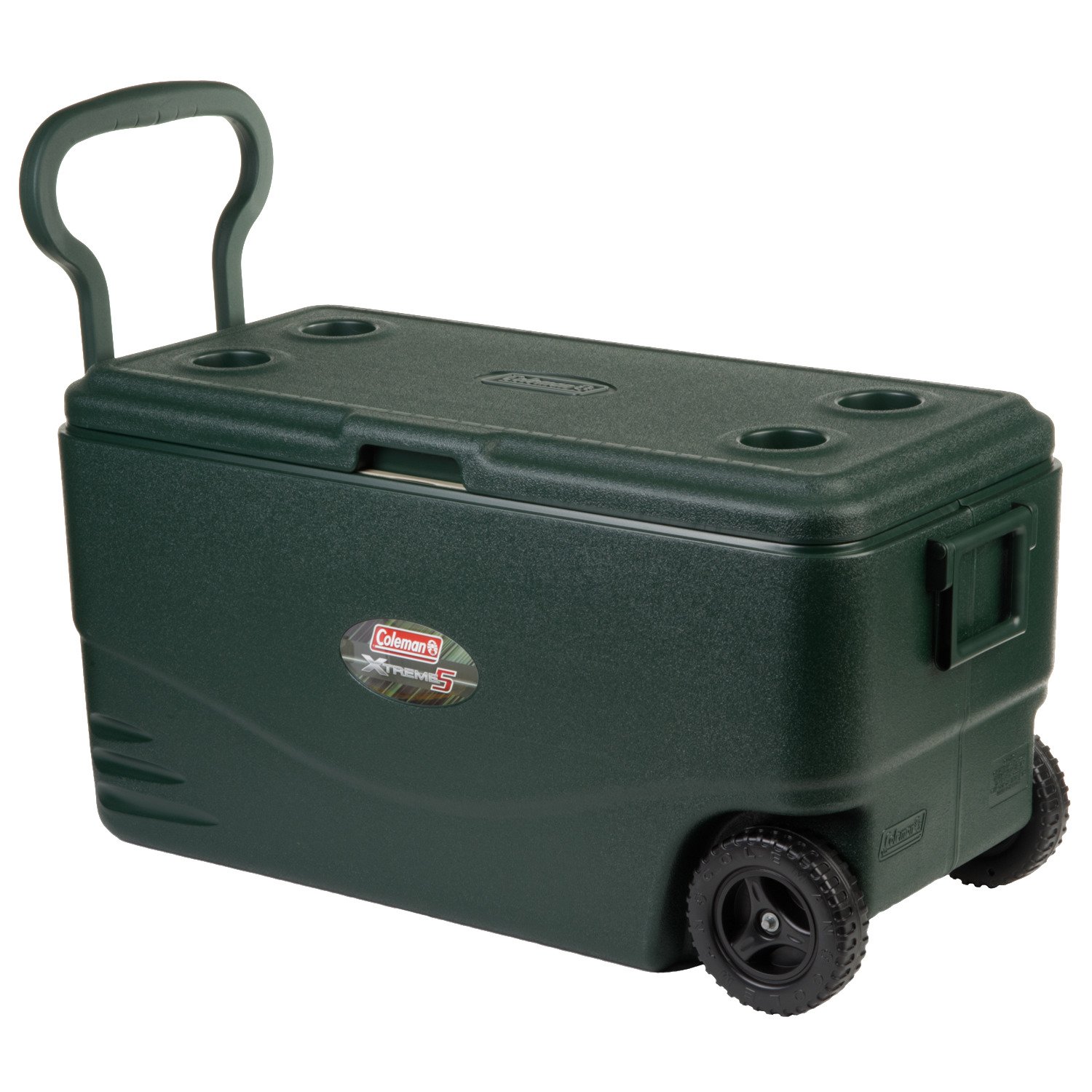
First, we scanned the cooler selection at Academy. We chose the 100 qt Coleman Xtreme because it was large enough to fit 2 kegs side-by-side with several inches of ice between them, and it had wheels. Not to mention, when waiting 20 minutes in line at Academy, it makes a handy impromptu bench. (Seriously, why is it that every time we go to Academy, it looks like the panic shopping done before a hurricane?! Why does everyone need to rush out all at once and buy 4 Yeti tumblers?! Is that a freaking priority?!)

Coleman Xtreme 100 quart cooler

Next, I made a template of the each keg with a slightly larger diameter to allow each keg to slide in easily without letting too much cold air escape. I measured a piece of string at about 4.75" between the center and the circle, tied them to a chopstick and a pencil, remeasured because knots take up some length of string, and then traced a nearly perfect circle onto a pizza box lid. We lead a glamorous life, in case you haven't noticed. I then cut the circle out using a utility knife and realized my template was about a half inch too big. To correct this, I set a keg on top of the template and just traced the damn thing. Much better. Do this the first time. Chopstick, string, and pencil, what a bunch of b.s.

This is a stupid way to do this. Just trace the keg on some cardboard.

Once I was pleased with the template, I pulled two empty kegs out to test the location of each in the cooler. I wanted enough room between them so that they would have an adequate amount of ice surrounding the entire keg. I also wanted to keep from destroying the cup holders on the lid, just in case I wanted to use them. Once lined up, I placed each template on the lid and traced the outlines with a sharpie.

After you trace your templates, drill pilot holes and then jigsaw!

The next part can get a bit messy. The styrofoam used in these coolers makes a fine, statically charged powder that works its way into all cotton clothing. It also goes all over the place, and I'm sure it's not the most environmentally friendly stuff. Make sure to do your cutting and drilling on a hard surface (not carpet) so that you can easily sweep up after yourself.

To cut each hole, first start with a pilot holes drilled inside the circle template. You may have to drill a couple holes next to each other to allow the jigsaw blade to fit down in there. Once you've got the room, carefully saw just outside of the sharpie outline. Test to make sure your kegs fit. I had to adjust a few areas because ain't no such thing as a perfect circle.

If they fits, they sits.
Swell! Now time to drill some holes for your faucet shanks. I used a 1" hole saw to drill through the front of the cooler. You want to make sure you located your faucets just to the left or right of where the keg will be. Remember that the shanks will need a little bit of room for you to tighten/remove hose clamps and beer line eventually.

Faucets should be a few inches either side of the keg to allow
shanks/connections/beer line enough maneuvering room.

That's the general idea!

For a decorative touch, we decided we wanted a couple patches of chalkboard paint on which to display the beer names. If you live in Texas, you're well acquainted with coolers, so you know the outer surface is some weird kind of rough, uneven texture. Not the best for reading chalk writing. We taped off the area we wanted to paint and sanded it for a while to make a semi-uniform surface. If you have the time and interest, you can go from 60 grit to 100 to 150 and try to get that sucker baby's butt smooth. I got through a couple swatches of 60 grit, poured sweat, and decided we had achieved
the substrate we needed.

Screw sanding. It's never easy or fun. Or done.
It's important to note here that masking tape is much more easily sanded than plastic, so you may have some little straggling strips of mangled tape left behind. No biggie, just get the larger pieces and don't sweat the small stuff. Next, we re-taped the areas for painting and applied about 4-5 coats to make sure we had a good, relatively smooth surface of chalkboard paint. When you remove the tape, make sure you don't accidentally peel up the paint with it. We had a little corner touch up to do because of this. If you want to get fancy and paint some kind of border around each chalkboard patch, go for it. We might or might not do that, haven't decided yet.

Chalkboard paint going on
Finally, you'll need to drill one hole each for the beer line to enter the cooler from the top of each keg. I previously located my beer line holes inside a molded cup holder, but it would be nice to be able to used those guys. Instead, I split the distance between the cup holders and drilled a 1/2" hole on each side. Once you hook up each keg, get as much of the beer line back inside the frosty interior of the cooler as possible. Even though vinyl tubing does not transfer heat very well, every inch that's out of direct sunlight and Texas summer heat is an inch of cooler, more predictable beer. Assuming you've calculated the length of beer line you need correctly, you should have no trouble with foaming issues.

Keep that beer line cold!


And there you have it! We gave our setup a dry run and tweaked a few things here and there to make for a smooth operation come festival day. If any of you have recommendations or better ideas, please comment below! Thanks for reading, and happy building!

I shall call it the Beerhemoth.

Friday, August 28, 2015

Better Know Your Brewers: Shannon Brewing


When I'm not homebrewing beer or blogging about it, I work in Keller, Texas. Last year about this time, Keller was blessed with its first craft brewery, Shannon Brewing Company. Located a whopping 1/4 mile from my office, I decided to head over to the brewery, grab a pint of dry-hopped Irish Red on nitro, and talk with founder Shannon Carter.


What was your career before brewing?

I was in brand strategy and brand design. I did brand and product development for companies like Whole Foods Market, USAA, Fiesta Bowl and several others. That experience really helped me develop the brewery’s product line and the type of experience we want people to have here.

How did you first become involved with brewing?

Homebrewing, like a lot of other brewers. I played soccer all my life, and I played for a team in St. Louis after playing in college. One of our sponsors was a homebrew supply, and they brought over a very basic extract kit. Coach asked if anyone wanted to take a run at it, so me and a buddy said we’d try it out. So that was about 30 years ago. It’s a different world now man. We had no internet to look stuff up on, we had no brewers to call on. We were just makin’ stuff up as we went.
“What style is this?”
“I don’t know. What does it say on the box?”
“It’s a brown.”
“What’s a brown?”
“No idea. Let’s make it!”

Did you brew many different styles, or did you repeat a few recipes to “tune them in?”

They would give us a kit a week, so we were brewing new things every week. We would bottle at first and then we started going to kegs pretty quickly because they traveled easily. We kind of got this reputation for a soccer team that would bring beer to every game. It was fun. Just all over the map. At that point in my life, beer was beer was beer. Playing in St. Louis, guess what we drank? Budweiser, all the time, just flowing through the streets. And so all of a sudden this world opens up to you of all these different styles of beers. So it was kind of a blessing, and it was my introduction to different beers. That was really the start of it, realizing beer wasn’t a product. It was an entire category. And it’s funny, I still run into people now that when you say beer, they still think BMC (Bud, Miller, Coors) is beer. No, it’s a really narrow product segment, albeit really successful. Can’t knock a success, but it’s a really narrow product segment of this HUGE category.

Just a leaf on the tree. So what would you say was your significant improvement in homebrewing, whether it’s technique, equipment, etc.?

Over the years you brew a lot of beer. Early in my homebrewing days, I was like a lot of homebrewers in that I’d start brewing, and soon after we’d start drinking. It was just fun, and it became a social event. Even guys who didn’t like brewing would just come over and hang, and talk and everything, and as a consequence, we didn’t take great notes. People would go, “Man, that pale ale you brewed was fantastic!” and I’d say, “Yeah it really was. I wonder what I did there…” And so you kind of get to practice, but don’t get any better because you’re not paying attention. It wasn’t until I really started taking diligent notes, and I know some homebrewers are going to hate hearing this, but I stopped drinking during brew day, that I got really good at brewing. Because when you’re drinking on brew day, you’re thinking ‘eh, I’m not going to take that gravity reading, I’m tired, I’m not going to clean up now, maybe tomorrow, or a week from now.’ You’re not paying attention so you don’t learn anything new.

Just a peek inside...

Where you ever in any homebrew clubs, outside of the soccer team?

No, I looked at joining a club when I moved here to DFW, but I was doing this, I was working, and trying to get the brewery off the ground and just didn’t have a lot of time. Plus, I was already brewing and doing this recipe development, so joining a club would have just been too much. I wanted to join a club. I think it’s a great thing. The camaraderie that’s there, you learn so much from your fellow brewers, and you get to share. Had I had more time, I think it would have been fun.


So when did you start to narrow down your styles? Are a lot of your commercial beers similar to the recipes you brewed as a homebrewer?

About 8 years ago I got really, really serious about this, and I started doing recipe development the same way we do product development professionally. We’d get the product about where we wanted it and do some variations on the theme, all presentable and good variations that maybe you can’t figure out the difference. We’d do various blind taste testing, usually A/B testing and we would let the data take our good product and hopefully make it great. Or certainly a higher percentage of a sample would enjoy it. I’m not so arrogant as to think that what I think is the best beer is the best beer. I would much rather take what I feel is the best beer, put it up against other things that I think are equally as good and let the data show what really is the best. I developed several recipes of the recipes we brew and sell today that way. Our Irish red, our IPA, the stout, & the blonde were all developed that way.

Now our seasonals, we don’t develop that way. After you brew long enough, you get a pretty good feeling for how the beer is going to turn out. By the grain load, the hop load, boil times, alpha acids. There’s a lot of calculations you do, plus we use several different tools to help us design one-offs and seasonals. We won’t do A/B testing for those, we’ll just hop right into a 20 or 40 barrel batch and just go for it. Like the bohemian lager we have right now. And the next time we do that, will I tweak it a little bit? Maybe. But it means that we’ve taken meticulous notes pre-brew, during the brew, during fermentation, during packaging, and then tasting notes, all of which are archived for the future for us to pull them back out when it’s time to do this beer again. You can’t leave anything to memory because guess what, you’ve probably had a beer since then.


What made you decide to consider professional brewing?
The thing that was instrumental in launching Shannon and really why I started to do it was my grandfather. He was a brewer in Ireland and he had some notes on a brewhouse that he built. My dad gave me these notes because he knew I was interested in brewing, and at the time I thought, ‘yeah, yeah, fascinating’ and kind of locked them away. When I started getting interested in doing this for a living, I pulled those back out and it was almost an epiphany. I was reading about how he built a cart and track and he would either move the fire under the liquid, or move the kettle over the fire. It was unclear exactly what he was doing, because he was saying what he was building and not what he was using it for. And I looked at it and figured out he’s doing a stepped temperature mash. So I thought, ‘That’s cool. Does anybody do a stepped temperature mash with fire?’ I started doing research and everybody would say, “Oh good God, you wouldn’t want to do that. That’s a terrible idea. You’ll scorch the wort under the false bottom.” But I thought to myself, ‘Yeah, well… how did they do it then?’

Shannon still uses the 55gal homebrew
setup for pilot batches
So I read his notes and built a couple of systems off of them, and I actually tried to build one exactly off his notes. It was cool, and it worked out okay, but the false bottom was made of birch strips in a basket weave pattern, and it worked! It just tasted terrible. It was awful. It may have been the wrong kind of birch, or I didn’t cure it right. He wasn’t super clear on that, he just said to use birch. It was probably sap or something. I could have chased down that path but I decided to just use a traditional false bottom. I don’t have to be THAT authentic.
 So I started experimenting and found that I could actually do the stepped temperature mash with fire. It’s a huge timing process you have to hit, and we found it. Our actual commercial brewhouse is just a scaled up version of this homebrew setup I built, custom engineered and custom built system. It’s a fire brewed process, and that’s why each bottle and can says ‘Fire Brewed Irish Ales.’


Your Irish heritage is intimately entwined with the identity of Shannon Brewing. Were there any commercial Irish style beers on which you modeled your recipes?
I took inspiration from a lot of European breweries. I started exploring different beers of the UK like Boddington’s, I loved Bass, loved Guinness, Harp lager. I really developed a love of English, Scottish, and Irish ales and lagers. I certainly liked German and Czech beers, too, but there’s something about Western Europe that I’m just drawn to. It’s homeland for me. Here in the States I drew a real interest in Sam Adams early on. They were kind of the jumping off point for American brewers at that time. I admire Deschutes, New Belgium, and Sierra Nevada is a great brewery with a great product. Although I really like European beer, I certainly dig west coast IPA’s. Everyone was doing west coast IPA’s and I didn’t want to be just another flash in the pan, so I figured we needed to remain true to where all this started for us. And for us it was Irish Ales. We go beyond that, we push some of the Irish influence into an Americanized brew. For instance, the red is really an Irish red, but then we kind of hop it up a little bit. Everything really takes its influence from the UK. We let it be an influence rather than a guiding principle. Some we just want to knock out of the park with true Irish style though, like our Cream Ale. It’s a true Irish Cream Ale, brewed the way Kilkenny used to brew it in Ireland with a dual fermentation: ale fermentation and then a lager fermentation.


 How has the Keller community responded to you in your first year?
Oh man, Keller has been great. We couldn’t have better community support. From the local government all the way down to the people of Keller. They’ve embraced us, we’ve embraced them, and it’s been a really nice fit for us here. There’s a guy Mike that lives right behind us. We had to tear down part of the fence during our construction process, and at that same time we were watching him put in a gate in his backyard across the drainage ditch from us and I asked him, “Hey Mike, what are you doing?” He said, “This is my way to the brewery! Don’t you put that gate back up!” So he just walks over across the ravine to come to the brewery. That’s how it’s been for us.

You are hosting a homebrew competition in November called Operation Bravo. Can you tell me what it’s all about?
It’s a homebrew competition that benefits veterans, and the judges are going to be veterans as well. It will be on November 7th, right here at the brewery, and we’re sponsoring along with Homebrew for HeroesT&P TavernTexas Brewing and some Keller staples: DeVivo Brothers and Hook & Ladder Pizza. There will be an award for crowd favorite, and we’ll take that recipe and make it a homebrew kit “Picked By Heroes” available nationwide. The big winner of the contest, we’ll get to do a Pro-Am with them. It should be pretty fun.

Your beer garden features several vines of hops. What variety are they, and how have they fared in the Texas heat?
Texas-grown Cascade hops border
the beer garden

Well, they’ve been just beat up by the sun. But it’s all Cascade. I think a lot of them will survive and come back next year, and we’re going to put a roof over the beer garden, so all of that will help. They just need a ton of water. Every day. A lot of resources say they love full sun, but I think it’s a different sun over Texas than the Pacific Northwest where they’re mostly grown. I used to grow them quite a bit in Austin, and they grew really well. Cascade grew the best down there, so that’s why we invested in it up here.

How long have y’all been in cans?

Just here in the last month or so. I’m excited about it. I’ve been talking to a lot of other DFW brewers that are canning now and everybody loves it. It’s just better for the beer. Plus I think ours turned out great. Our beer is all about being really simple, approachable, and drinkable, and we wanted our packaging to reflect that. It’s really simple and toned down and elegant. What’s more elegant than a tuxedo?  It’s so easy to over-design something, and every kind of hop pun has just been done to death. A lot of other breweries will make you guess what’s in the can or bottle. With us, you know exactly what kind of beer you’re grabbing; it’s right there on the can.

You are one of few breweries in the area to offer your beer for to-go sales, including kegs. Have your customers responded to this option?

Yeah, definitely. We sell beer every day. Bottles, cans, and kegs too. It’s a hard license to do because you have to have a trifecta: City Council approval, light industrial zoning to brew beer, and then you have to have a retail overlay to be able to retail. That doesn’t happen often.

Do you have any new beers on the horizon?

Yeah actually, next week we’re going to brew a Honey Porter. We are also going to re-release a lot of our 1st year success stories like the Winter Stout, the Chocolate Rum Stout, the Cream Ale and others.

Congratulations to Shannon Carter and his crew at Shannon Brewing for making it through their first year on the DFW craft beer scene. Make sure to check out their facebook, twitter @ShannonBrewery, website, and of course stop by their tap room and beer garden if you're in Keller.  

Saturday, August 29th is Shannon's First Anniversary Celebration from 11am to 6pm with all kinds of eats, treats, and of course some great Shannon beer! Tickets are $15 online and $18 at the door.


Thanks again to Shannon Carter for taking time out of his busy schedule to talk with this lowly homebrewer. We'll see you at Operation Bravo!

Friday, August 21, 2015

Better Know Your Brewers: Division Brewing


We posted last month about a great tasting party that the folks at Division Brewing invited us to. We were blown away by the great beers that owner/brewers Wade Wadlington and Sean Cooley had produced, so we sat down with them to learn a little more about Arlington’s first locally-owned craft brewery, opening this fall.


How did you first become involved with brewing?


Wade: I began appreciating import beers in the early nineties. There were not many craft breweries around or readily available, so the decision to brew my own was pretty natural. My first Texas craft beers were Celis White & Grand Cru, which became available around 1994 or so.  I continued to enjoy and search for new imports and craft beer until I had tried every single one available. Then in 1999, I went to Homebrew Headquarters (which was in Arlington at the time) and brewed with the owner right out on the sidewalk.  It was your basic kit beer, but the experience of brewing a beer for the first time was magic to me.  That first batch was not that great, so I brewed again and again…and again.  Always asking myself, “What can I do right this time that I did wrong before?”   This was before the home brewing explosion, so reference material was basically the Papazian book, which is still a viable resource today.  It’s so much easier these days to just pop on the internet and google information.

Sean: Early on, it was country wines, odd and often foraged ingredients for the beer. I was pretty biased against liquid malt extract, maybe unfairly, so I used dry malt extract for the base and added things like dandelions and wild herbs to the beer in mainly 2 gallon batches. I slowly took on the intimidating task of learning all-grain. A lot of it came down to distribution issues. You hear about a lot of great beers out there but you can’t get them, or you don’t want to pay for them. Also that do-it-yourself spirit that both Wade and I have and a lot of homebrewers have. 

W: It’s much more satisfying to provide the solution than to buy it.

Did you brew many different styles, or did you repeat a few recipes to “tune them in?” 


W: I tried a few different things early on, and it was just craziness, like my third batch of beer was an imperial cherry stout. But then after that I was pretty focused on brewing beer that I like to drink. At that time I was moving from European hoppy pilsners to IPAs that were starting to show up here. So it was finding something in between that I was challenging myself to do. As the craft beer scene started growing, and more choices became available, it pushed me to make better IPAs and questioning is this right, is this what I want it to taste like? What it comes down to is you just have to brew your ass off. Once you get the process down, the freshness itself becomes a dominant factor.

S: Before opening up a brewery became possible, I didn’t really brew anything twice. Pretty much the same styles that I brew now, I’ve always been brewing. I can’t say my tastes have changed very much: IPA’s, Saisons, sours. And I’ve always done a few dark styles like porters and stouts. But I would change up the recipe each time. I would do different things with each brew. One thing about brewing: recipe formulation is important, but knowing your process is more important. I think I learned more about brewing not by brewing the same recipe over and over and over again, but just dialing my process in each time.

What was the most significant improvement to your homebrew setup?


W: Whirlpool was one of the things that for me was a game changer. I brew a lot of IPA’s and hoppy beers, and I discovered the importance of it with stirring. I’d get distracted with other people here during the brew session, and notice that something was lacking in the hop character, and it was not stirring enough to get more hops utilization. I bought our new equipment (Stout Tanks & Kettles) so that it had the whirlpool feature, and it’s awesome. It leaves a cone in the center once the wort is drained off that’s just huge. Whirlpooling I think is a missed opportunity with a lot of homebrewers. They get in the habit of set it and forget it, and I think they’re missing out, especially with late hop additions.

S: Yeast management was one of the biggest ones for me. Temperature control has been good, but knowing your yeast and having an idea for what expression you want to get out of it is important. Not just pitching a yeast because it’s what the recipe says to do, but what do you want out of that yeast and what can you do with it in order to get that expression out of it, whether it’s a clean profile or fruity or funky.

What was your favorite homebrewing experience (competition, party, brewday, etc.)?


S: We’re in them, I think.

W: Livin’ the dream of it. I think most of ours have been the sharing of the finished product. I’ve gotten to where the brew day for me, I like it to be peaceful with nobody around. And then I like to open the doors once everything’s done and then let people try it.

S: Yeah, these tasting events with people have been great.

What made you decide to consider professional brewing?


W: Seeing 300 or 400 people drinking locally made beer at the breweries. I really enjoy the beer making process but I think the decision to go ahead and do it professionally had a lot to do with the success of the new local breweries and the large amount of people that were honestly enjoying craft beer. I have a product that I’m proud of and I just want to share it with a larger group of people. Being a craft beer lover for a long time in DFW area, there were places like Copper Tank, Yegua Creek, Rock Bottom, and 2-Row Brewery. They were places where you’d go in and have a beer or sit down at the brewpub and enjoy a meal.  Those places have come and gone and I never saw the enthusiasm or numbers of people coming out to enjoy craft beer until recently.  It’s fantastic!

S: Wade had this in the back of his mind before I even met him, and it may not have been very long once I knew you, but you seemed like a determined person, and this seemed like something you wanted to do. I decided it doesn’t matter what it is, I want to be a part of that. If it was cleaning kegs or whatever, I wanted to do it.

W: A lot of good brewers are good cooks, and they really enjoy all the little preparations, all the little facets. We were both cooking a long time before we started brewing. It’s just the handling the raw product and turning it into something special. It’s a good feeling.

Were there any other commercial breweries that inspired you to start your own?


W: The ones that have inspired me are the west coast places. After reading for years about Pliny the Elder, and going out there and seeing it first hand, you’re looking at what they’re doing behind the scenes.  There’s a passion and attention to detail that really makes Russian River Brewing and a few others out there stand out.  Also in Europe, Ayinger Brewery was a big inspiration. I’ve always respected them. Their Celebrator Doppelbock and wheat beers are awesome, some of the best available. And if you research their past, they have their own farms and used to grow everything on their estate. Not many people do that, or can do that. Certainly Rogue is getting there with Rogue Farms, but it’s rare the way Ayinger has done it.

S: He came back from California with Russian River’s Sanctification, and I just so happened to have 2 gallons of a saison that I split into 1 gallon each, so I pitched the dregs, and it kinda became our first sour. I mean I had no idea what I was doing, I was just tipping some bugs into a beer, you know. Jester King has been an inspiration for me, and also a frustration for me because they’ve done so many things with their beer. I’ll have an idea and want to do this with my beer, and I’ll look up if anyone has done it, and of course Jester King has. Like beets. I thought has anyone done beets in beer, and sure enough Hibernal Dichotomous is this great seller. They’ve just done it all, and they’re great. They really inspire me.

What is your idea of a hypothetical “perfect beer?”


W: It depends on the setting, but 90% of the time it’s going to be a 9.0 (ABV) double IPA that is well balanced. I can appreciate every other style of beer just about, but that’s my go-to. I do love a good European, maybe British style ale too. I love stuff on cask, and I want to get something on cask at JR Bentley’s, the newly re-opened British pub in downtown Arlington. We’d love to do something with those guys.

S: It really depends. I have a lot of favorite beers. You can ask me again in the middle of winter, but especially now drinkability is really high on the priority list. I find myself dropping my kegerator down like 10 degrees in the summer because I want something that’s cold and refreshing. I love saisons, but I really do love hoppy beers, and I prefer something that’s pretty dry, personally. 

To keep the interview going, we cracked a Flanders Red, just the base style without any finishing fruit. Delicious, crisp, not overwhelmingly sour, approachable, great malt presence with some leathery, brett character that will continue to develop in the bottle.


You will have a dedicated sour program at Division. Will there be any particular sour style that you focus on, or will you have a variety?


S: We’ll be brewing dark, golden, amber, but as far as what we do with them like fruits, as long as we have a decent supply of fresh ingredients it’s wide open. Sours are becoming a real big deal in America lately, and there’s been a lot of bleed over from the culinary world. I really like that, but then deep down what I really enjoy is simplicity and expression of ingredients at their best. If you look at a recipe and there’s a hundred ingredients, you can get lost in that. Sometimes, the best things can be simple. If it’s brewing with fruit in a sour beer, it’s using fresh fruit that’s in season.

W: As much as I like a really good peach, just ripe and ready to eat, I know it’s going to be that good or better in the beer. I wouldn’t mind if we just keep throwing out new ones all the time. We know people will want some standards or go-to’s like Franken Froth, RosaLee, Xmas Morning or Ben Stout. But when we’re playing with the freshest ingredients we can get a hold of, it’s going to be great. Like wholesale hops, too, not just fruit. We’d like to get some great rare or experimental hops like we did with some very fresh Galaxy we just received. The orders flew in, and we bought as much as we could, and they were sold out in like 15 minutes. So we’re going to brew with these hops in a few weeks and it’ll be as fresh as possible.

Sean’s bio on the Division website says he likes to preserve and/or ferment foods. What was the best aged food you’ve ever made? Weirdest?


S: Cheese is one of those things we take for granted how weird it is. When you see a whole wheel of cheese and the rind and everything, it’s… just weird man. It tastes great and everything, but it just weirds me out a little. Whenever it was cool outside we’d stick sausages on our back porch and dry them out, and that was pretty crazy, but it was fun to do and it turned out good. I’m pretty lucky I didn’t get botulism or anything. We cured some pork loins too. The one thing I do on a regular basis is sourdough bread baking. That’s something that I really take time aside to do. Starting a brewery is pretty all-encompassing, but I think I’ll always make time to bake sourdough. That was the first thing my wife and I did the first week after our honeymoon. It became our daily bread, and it symbolized more than just food on the table.

What advice would you give the average beer drinker in order to convince them to try sour beer for the first time?


S: The one thing I’ve used that I heard from Jay Goodwin at the Rare Barrel was the three sip rule. The first sip is going to shock your palate because it’s quite different, and the second sip kind of lets your palate acclimate. Hopefully by the third, you’re good to go. You’ve made up your mind. Some say they’re not for everyone, but I think they are. 

W: For a lot of people, the name sour kind of hurts the genre. You say sour, and they think it’s gone bad or something. There’s some negative connotation implied by the sour label. That’s not the case at all. I find them refreshing and complex…the kind of beer that is contemplative; you pour, sit and think about it.

S: A lot of times people are basing the credentials on pH or how sour is it. I’m definitely proud of the sour beers that I brew and the complexities in them like brett character. Yeah, I want it to be drinkable and thirst quenching for the Texan drinker, but you let them warm up a little bit and there are some complexities for the contemplative drinker. There’s something for everyone I think.

Do you see Division growing into a large operation like Stone or Dog Fish Head, or would you rather stay local?


W: We really like the idea of being small and creating an atmosphere that draws people to the brewery. I sometimes feel that the larger production facilities that churn out large amounts of beer, good beer mind you, somehow lessens the human aspect of brewing. For me, it’s always been about the people – the brewers, the servers, the customers, everyone should feel connected to the brewery through the beer. It would be fun to have a large vibrant company with lots of employees making great beer on a larger scale, but we’re going to let the beer speak for itself and let any expansion happen naturally.

Where will craft beer fans be able to find your beer? 


W: The main idea has always been to get people to come to the brewery. We will have a tasting room onsite with hours TBD, but initially we want folks coming out to the tours on Saturday afternoons 2-6pm to learn about us and try our beers. We will eventually have tasting room hours, likely Thursday and Friday evenings. We will also have to-go sales, so folks can grab bottles, growlers and even whole kegs to take home. We want to be able to sell the beer we send out, too. If something isn’t selling, then we’ll pull it once the freshness isn’t there anymore. If and when we go outside of Arlington, it’ll be places that respect the beer. But first and foremost, it’s Arlington. It’s our beer.

Downtown Arlington is a great place to have fun and a good beer or two. Between craft beer bars, music venues, events hosted by the City of Arlington, and great restaurants, do you see Division becoming a community presence in Downtown Arlington? 


W: Absolutely. The City of Arlington does a tremendous job with all of its great year round events and festivals, especially the concert series at the Levitt Pavilion. The City has been great throughout the whole approval and building process, and the support they are showing us is very encouraging. Throughout the process of opening the brewery, we’ve gotten to know a lot of the businesses downtown, and it’s very much a community that we are excited to join, and I think they’re excited to see us coming onto the scene. Groups like the Rotary Club and the Maverick Rugby Club have reached out to us, and we’re very fortunate to be joining that great atmosphere. We’ve lived in Arlington for a long, long time, and we feel that a lot of people in the Metroplex and especially Arlington have been waiting for a small, locally-owned, hometown brewery to open mid-cities for a while. We can’t wait.

Neither can we! You can check out Division Brewing's website, facebook, and twitter @DivisionBrewing for the latest on this great new craft brewery. Make sure to give them some love, and get on the mailing list for Division news and events.


A sincere thank you to Wade, Sean, Tammy, and everyone at Division for allowing us beer nerds to come into your home and talk about brewing. You guys are rockstars!

Thursday, August 13, 2015

Sorry for the delay...

Apologies for missing this week's post of juicy homebrewing news and opinions. We've been working on a special project that we hope to begin next week. We'd like to keep it under wraps for the moment, but suffice it to say we've been getting some great content for the blog with a little help from our friends.

In the meantime, we've been scanning the interwebs for great beer and brew-related infotainment (and FREE), and we'd like to share with you what we've been listening to during our commutes. Click each link below to be magically transported to their respective web pages.

Local folks:

A Typical DFW Podcast - A hilarious bunch who say what we're all thinking. They can get a little blue, so maybe not the best for a G-rated family road trip to Six Flags. They talk about great beer, comics, games, movies, and whatever weird crap crawls out of the internet every week.

Dallas Brew Scene website - Good compendium for beer and beer-related news in the Metroplex. They even have beer industry job postings and something called a Brew Bus!

Steel Rain Beer Blog - This is a fellow homebrewer in Lewisville that just happens to be an Aggie. He has some awesome recipes and great write-ups. Whoop!

Other beer/brewing blogs we like:

Brulosophy - I read this blog/website religiously. He's brewed and reviewed all kinds of stuff, and he uses the Scientific Method in what he calls exBEERiments to answer the many confusing or inconclusive questions homebrewers face. Great resource.

The Mad Fermentationist - For those who are looking to get a little more advanced with their brewing techniques, this is the stuff to read. He also has a book out on brewing sours.

And of course, the classics of beercasting, from the 
Brewing Network:

Sunday Session Podcast - A collection of homebrewers and beer industry folks who sit around for a few hours and talk about whatever comes up. Wouldn't ya know it, most of the time it's about beer!

Brewing With Style Podcast - For those homebrewers looking to win some BJCP competitions, a trained panel of judges, homebrewers, and professional brewers discuss each and every style in the book with commercial examples and recipes you can try at home.

Brew Strong Podcast - The be-all and end-all for homebrew how-to. Hosts and leading homebrew authors Jamil Zainasheff and John Palmer talk homebrewing to death and answer any questions one might have about the hobby. They also invite tons of special guests from the world of homebrewing and commercial brewing to share the beer gospel.

There's an endless array of information and entertainment out there on the world wide web, and this collection of the finest free sites is just the tip of the iceberg. If you're looking to become a better brewer or if you just want to shoot the breeze with some craft beer fans, give these fine folks a click. Happy hunting!

Sunday, August 2, 2015

American Homebrewers Association Rally - Community Beer Co. 2015

This past weekend was the AHA's local rally for homebrewers in the North Texas area, held at the best of Big D's Favorite Brewery, Community Beer Company. The event was free to AHA members and designated drivers, and it featured exhibits from our favorite local homebrew shops (LHBS) and great beer on tap from Community.

We were fortunate enough to talk with a few homebrewers from across the Metroplex. We stopped off with a couple of folks relatively fresh-in from Lubbock, TX, where the craft market has been slowly but surely taking hold. Now that they are in the MetroMarket, they can finally explore their passion for Texas cider and mead from many favorites such as Bishop Cider Co., Leprechaun Cider, & Meridian Hive.


Aside from general elbow bumping and great Community beer, the AHA was well-represented by volunteers who were happy to pour a pint, conduct a well-stocked raffle, and sign-up the uninitiated beer lover at the door. Though the event was free to AHA members, visitors were offered the option to become one of the newest proud members of the American Homebrewers Association. You, too could become a member of the AHA at this very moment! Visit www.homebrewersassociation.org and for the cost of one batch of high quality homebrew, you will be adopted into an amazing community that furthers the cause of the American homebrewer while protecting our rights and ensuring a future for the hobby. Always mindful, the AHA allowed all designated drivers free admittance to the rally so that we, the brewing few, made it home safely to brew another day.

All entrants were granted 1 raffle ticket for a plethora of pinatas prizes sponsored by our beloved LHBS's. They included nifty AHA ball caps, various brewing books and publications including the standards (John Palmer's How to Brew and Randy Mosher's Radical Brewing), and the grand prize was a stainless steel brew kettle from Texas Brewing Inc. equipped with a brewmometer, ball valve, and volume markings for a quick and efficient brew session. Though yours truly didn't win (despite both Amanda and I entering the raffle, being AHA members), those who captured the door prizes left better brewers than when they came in.

Texas Brewing Inc. has a fine selection of brew kettles
 and everything else you need for your brew day
We lucky few were also granted a VIP tour of the Community brewery facilities. Our tour guide discussed the various elements comprising the state-of-the-art processes employed by Community to churn out the beer we have all come to know and love. Many fellow homebrewers asked excellent questions and received in-depth answers, lending to the overall helpful and friendly atmosphere of the entire event. 

Community Beer Company's great brew house
One topic that caught our attention was how our tour guide came to find brewing as his calling. He actually holds a degree in the finance realm, but after a few years werkin' fer th' man, he decided his interests laid elsewhere. He volunteered at several breweries before being employed as assistant brewer in not one, but two local craft breweries in Missouri. Upon his return to Texas, he volunteered at Community one weekend, and was hired the next.

The point that really hit home was his discussion regarding what he was willing to do for the profession. Ask any homebrewer worth his or her salt what they'd rather be doing, and you're likely to receive an answer resembling, "Brewing damn good beer for a livin', by Gawd." True enough, but once one looks into the prospect of becoming a full-time brewer, one may become easily overwhelmed by the time, effort, and physical commitment necessary to hold down a full-time brewing gig. For starters, read Tony Magee's So You Want to Start a Brewery.

We at New Main have extensively explored the option of bucking up and opening our own damn place. Aside from astronomical investment capital requirements, absurdly long hours, and a relatively high cost of start-up, craft beer is not a marketplace for the weak-spirited.

What really spoke to us was when the tour guide leveled with the intimate crowd of homebrewers and admitted after attempting to maintain multiple part-time jobs to keep up his lifestyle, he finally consented to lowering his standard of living. The craft beer industry rewards those who persevere, but one invests significant time and sweat-equity in the industry before accepting meaningful gains. In short, don't expect magnificent riches for a small amount of work. If the work is not reward enough to span the gap between your current salary and your commercial brewing income, keep your day job.

This challenge encourages those of us made of stronger stuff to really pursue our goals. We at New Main may be alone, but we believe the chief accomplishment one obtains as a homebrewer is turning out great beer for our friends and family to enjoy, time after time. Competitions help objectively separate those who know their stuff from those who have extensively sampled their own stock and kept the status quo. The real measure of a great homebrewer is their passion for what they do. Homebrewing is a great hobby. We love it. But a great homebrewer is made of the stuff that drives us to improve from batch to batch. A great brewer is someone dedicated to making each pint better than the last. A great homebrewed beer is one that has been fussed over, brewed the hard way, and absolutely been taken seriously from grain to glass. We consider it a high honor to keep supplying great beer to those of you asking for it.

Today's Main Break: The AHA hosts rallies across America to encourage homebrewers to meet up, drink some great beer, and talk with the professionals in their local craft beer markets. If you want to find a rally near you, check the AHA website for a list of upcoming events!


Thursday, July 30, 2015

Brew Schedule Update

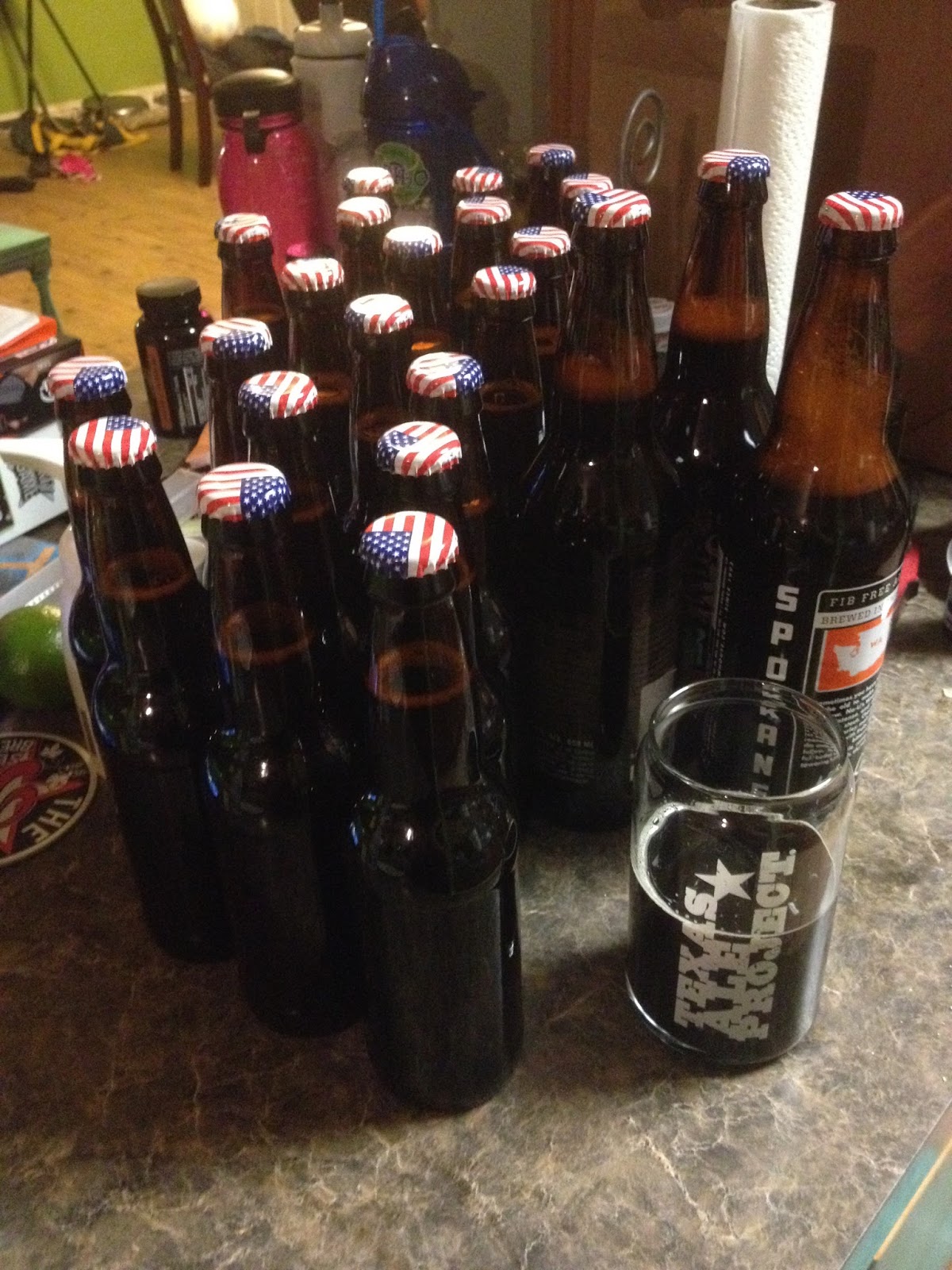
This week's post will be short and sweet. We recently bottled our Russian Imperial Stout 9*8*7 to continue conditioning for a few weeks prior to the Deep Ellum Labor of Love Homebrew Competition. Just so happens that the only crowns (bottle caps) that our homebrew store had were 'Murican flags! Boom. Freedom.

9*8*7 RIS
We also transferred our wheat beer onto some fresh peaches and apricots. We read that you get better peach flavor and character using apricots instead of peaches, but we didn't really want a cloying-each-sickly-sweet flavor in the beer. We pasteurized and smasherized 1 yellow peach, 1 white peach, and 3 apricots in our 3 gallon batch of wheat beer. We still aren't sure how it will turn out, but everything was tasting right when we were mixing it all together. If it turns out well, I'll post the recipe. If it sucks, we'll just pretend it never happened.

Millions of peaches. Peaches for me.
Into the secondary

I ran out of time and didn't get to brew the Tamarindo Gose early enough so that it would be ready for Labor of Love. Major bummer. I've emailed the event coordinator to see if I can substitute something else, but if not, the RIS will be flying solo into the judges glasses. Fear not, I will try to get it brewed this weekend in time for another competition we have our eyes on, Operation Bravo at the Shannon Brewery in Keller. The competition is Saturday, November 7, and it honors our veterans with great homebrewed beer. More on that at a later date.

Our Pale Ale, which I just realized we haven't named yet...

In the meantime, the Pale Ale we brewed for a friend's bachelor party went over very well! Many of the guys that drink the big 3 said they really enjoyed it, and we floated the 5 gallon keg in just a few hours. I really did enjoy that beer both times that I've brewed it, so I may keep that in rotation for spring and hop the hell out of it at harvest time in the fall. Sadly, my 3 healthy hop vines have been scorched by the ruthless and rainless July, so now we're down to just one little plant. Stay strong little hops! I'm still hoping against hope that I get to use some homegrown hops in one of my beers.

Last but not least, we brewed up 5 gallons of last year's fan favorite (from New Main, at least) Palo Alto Wit. Last year we brewed it with orange and lemon zest, rosemary from a friend's garden, and a small bundle of sage. This time around we tweaked the recipe with the intent of guiding the crazy recipe back towards the actual beer category of Witbier. We subbed the zest for a few hops that will exhibit similar citrus characteristics. We also scaled the rosemary back a little and added coriander. So no, this isn't a thanksgiving dinner beer anymore, not that it ever was, but the weird stuff has been exchanged for better stuff. We'll see how it fares at Labor of Love.

Until next time, keep drinking homebrew and I'll keep brewing it! Also, if there's anything you'd like to read about, leave us a suggestion in the comments below. Thanks for reading!

Today's Main Break: Craft Beer continues to grow in production here in America. Do you think we are headed for a bubble, or are we building the foundation for an expanded market?